Gerberlyte
Scientifically designed to rehydrate quicker than common beverages☨
Pediatric guidance, including recommendations from the World Health Organization1 and American Academy of Pediatrics, identifies oral rehydration solutions as first‑line management for mild to moderate dehydration associated with illness, intense activity, or heat.2
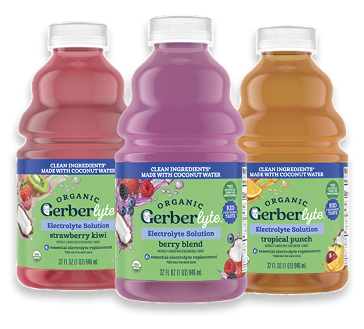

Made with coconut water to support palatability, while hydration efficacy is driven by the product’s electrolyte composition formulated in alignment with established ORS guidelines.1-5
Gerberlyte™ is designed as an ORS for rehydration1-5 with zinc for immune support.6-8

| Components | WHO Guidance1 | ESPGHAN Guidance9-12 | Strawberry Kiwi | Tropical Punch | Berry Blend |
|---|---|---|---|---|---|
| Glucose (mmol/L) | 75 | 74-111 | 73 | 73 | 73 |
| Sodium (mmol/L) AAP Guidance is 40-60 mmol/L13,14 |
75 | 60 | 49 | 53 | 49 |
| Glucose : sodium | 1 | 1 to 2.1 | 1.5 | 1.4 | 1.5 |
| Potassium (mmol/L) | 20 | 20-30 | 21 | 21 | 21 |
| Chloride (mmol/L) | 65 | 30-90 | 36 | 36 | 36 |
| Citrate (mmol/L) | 3015 | 10 | 28 | 28 | 28 |
| Zinc (mg/L) | — | — | 7.8 | 7.8 | 7.8 |
Category Comparison at a Glance
Gerberlyte™: Clean* Rehydration with Zinc for Immune Support
| Attribute | Organic Gerberlyte™ | Pedialyte® Original Strawberry | Up&Up™ Strawberry (Private Label) | KinderLyte® Fruit Punch | Liquid I.V.® Strawberry Sticks | Dr. Brown’s™ Watermelon | Cure® Hydration Kids Fruit Punch |
|---|---|---|---|---|---|---|---|
| USDA Organic |  |
 |
|
|
|
|
|
| *No Artificial Dyes† or Sweeteners | |
|
|
|
|
|
|
| Made with Coconut Water | |
|
|
|
|
|
|
| Zinc | |
|
|
|
|
|
|
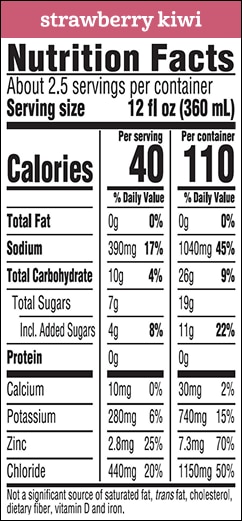
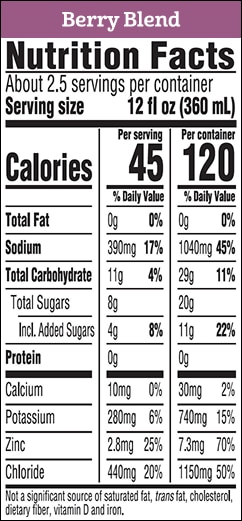
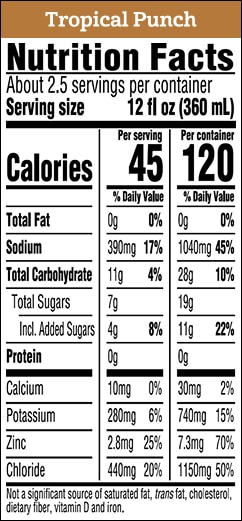
Strawberry Kiwi | Berry Blend | Tropical Punch
- World Health Organization. Oral Rehydration Salts: Production of the new ORS. 2006.
- Leung A, Prince T. Oral rehydration therapy and early refeeding in the management of childhood gastroenteritis. Canadian Paediatric Society Nutrition and Gastroenterology Committee. Paediatr Child Health 2006;11(8):527-31.
- AAP, Provisional Committee on Quality Improvement, Subcommittee on Acute Gastroenteritis. Practice parameter: The management of acute gastroenteritis in young children. Pediatrics. 1996;97:424–35.
- Imdad A, et al. Oral Rehydration Salt Solutions for Children: A Review. Pediatr Rev. 2025 Jul 1;46(7):355-365.
- AAP. Clinical Report: Oral Rehydration Therapy. Pediatrics. 2004;114(2):507–515.
- Gammoh NZ, et al. Nutrients. 2017 Jun 17;9(6):624.
- Padoan F, et al. Biomolecules. 2024 Jun 17;14(6):718.
- Shankar AH, et al. Am J Clin Nutr. 1998 Aug;68(2 Suppl):447S-463S.
- Guarino A, et al. ESPGHAN PID Evidence-based Guidelines for the Management of Acute Gastroenteritis in Children in Europe. J Pediatr Gastro Nutr. 2008;46:S81-S194.
- Guarino A, et al. J Pediatr Gastroenterol Nutr. 2014 Jul;59(1):132-52.
- Guarino A, et al. J Pediatr Gastroenterol Nutr 2018;67(5):586-93.
- Booth I, et al. J Pediatr Gastroenterol Nutr. 1992;14:113-5.
- Duggan C, et al. CDC. MMWR Recomm Rep. 1992 Oct 16;41(RR-16):001.
- AAP Committee on Nutrition. Pediatrics 1985;75:358-61.
- Freedman SB, et al. Arch Pediatr Adolesc Med. 2010;164(8):696-702.
☨Common beverages such as juices, sodas, and sports drinks. References: Freedman SB, et al. Arch Pediatr Adolesc Med. 2010 Aug;164(8):696-702. Maughan RJ, et al. Am J Clin Nutr. 2016 Mar;103(3):717-23. Millard-Stafford M, et al. Nutrients. 2021 Aug 25;13(9):2933. Powers KS. Pediatr Rev. 2015 Jul;36(7):274-83; 284-5.
† Added colors from natural sources